Prime Minister Imran Khan on Friday pledged to the people of Kashmir that his government will hold a referendum and they may choose to become an independent state, if they do not wish to join Pakistan. Addressed an election campaign rally in Tarar Khel, he rubbished talk of him “wishing to turn Azad Jammu and Kashmir into a new province of Pakistan”. “I do not know where all this talk has sprung from,” he said, dismissing any notion of such an idea. “But what I want to make clear now, is that in 1948, there were two United Nations Security Council resolutions which granted the people of Kashmir the right to decide their own future. According to the UN resolutions, the people had to decide whether they want to join Hindustan or Pakistan.
The premier went on to state that after the UN mandated referendum, his government will hold another referendum, where the people of Kashmir will be given the choice to either live with Pakistan or become an independent state. PM Imran Khan said the freedom struggle of Kashmiris pre-dates partition and began more than a 100 years ago, when the people stood up time and again against the Dogra government. The Dogra family was a dynasty of Hindu Rajputs who ruled Jammu & Kashmir from 1846 to 1947.
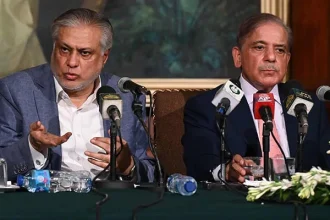
Mr Khan’s statement on the independence for Kashmir has elicited a strong reaction from his political opponents. Leader of the Opposition Shehbaz Sharif, in a statement issued on Saturday, said the prime minister’s utterance deviated from Pakistan’s historical and constitutional stance, adding that any attempt to impose a solution on Kashmiris without their will and consultation would amount to a betrayal of the Kashmir cause.
This is not the first time that Mr Khan has issued such a statement on Kashmir. Back in February, on the occasion of Kashmir Solidarity Day, he had also reminded Kashmiris that Pakistan would not stand in their way if they opted for independence after accession to Pakistan. Then too the prime minister had been bombarded with criticism for injecting the ‘third option’ into the Kashmir dispute whereas the UN resolutions only talked about the option of Kashmiris either joining Pakistan or India. Such criticism is not surprising in the acute polarised political environment, but it is entirely misplaced. There is nothing wrong in what he said. In fact, he appears to have given this statement deep thought as well as due legal diligence.
His statement draws strength from the Pakistani Constitution. Article 257 of the Constitution clearly states: “When the people of the State of Jammu and Kashmir decided to accede to Pakistan, the relationship between Pakistan and that State shall be determined in accordance with the wishes of the people of that State.” This leaves little room for ambiguity. Mr Khan’s statement is fully compliant with the Constitution and is in fact timed well to send a message to the people of India-held Kashmir and AJK that Pakistan will respect their right of self-determination.
The prime minister’s statement is also a welcome reaffirmation of the fact that Pakistan does not see the Kashmir dispute as a conflict over territory, but in terms of the UN-mandated right of self-determination for the people of the state. At a time when India is trying its best to erase the Kashmiri identity by revoking the state’s special status and engineering demographic changes, it is commendable that Prime Minister Khan has reiterated Pakistan’s principled position in clear terms and assured the Kashmiris that while Pakistan is a party to the dispute, it is the Kashmiris who will have the final say both in the referendum and afterwards.