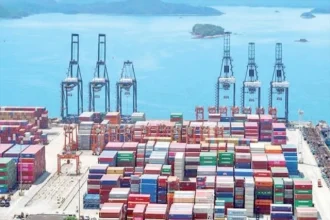
Pakistan has experienced a significant decrease in the trade deficit during the July-February period, driven by increased exports and decreased imports, according to the latest data from the Pakistan Bureau of Statistics (PBS).
The trade deficit for the first eight months of the 2023-24 fiscal year contracted by 30.18%, totaling $14.872 billion, compared to $21.299 billion during the corresponding months in 2022-23.
Monthly data released by the PBS reveals a 9% surge in exports, reaching $20.351 billion during the period under review, in contrast to $18.670 billion in the previous fiscal year. This reduction in the trade deficit is crucial for Pakistan’s efforts to enhance foreign reserves and minimize the import bill.
On the other hand, Pakistan had an 11.87pc decline in imports which was recorded at $35.223bn against $39.969bn in the same period of 2022-23.
Last fiscal year 2022-23 saw Pakistan’s net trade deficit narrowed by 43.03pc to $27.547 billion against $48.354bn recorded in 2021-22.
The latest data coincides with the encouraging news coming out of the inflation front as the prices in February rising at the slowest rate since June 2022.
This decrease in consumer price index (CPI) for the second consecutive month on year-on-year basis means the prices had risen by 23.1 per cent in February against January’s figures of 28.3pc. The CPI had reached its highest level of 38pc in May last year, which was recorded at 21.3pc in June 2022.
However, there was no change on month-on-month basis, says the Pakistan Bureau of Statistics (PBS).
When it comes to urban inflation, the increase in CPI was 24.9pc on year-on-year basis with a slight upward movement of 0.2pc on month-on-month basis.
But the rise in rural inflation measured through CPI was recorded at 20.5pc when compared with the corresponding month last year when it had touched 25.7pc.
It is mainly due to a declining trend in food prices that has enabled CPI to slow in February, as food inflation on year-on-year basis in urban centres was clocked at 20.2pc and 19pc in rural areas against the corresponding values of 27.4pc and 25.1pc.
As far as the change in month-on-month basis is concerned, the food prices dropped by 0.3pc in urban and 1.5pc in rural areas.
Meanwhile, non-food items too witnessed a similar trend in February, the CPI in this category recorded a 28.2pc rise on yearly basis for urban consumers and 22.1pc for rural consumers when compared the corresponding figures of 32.3pc and 26.3pc.
The interest rates in Pakistan are currently at the record high level of 22pc with a paralysing effect on economy which badly needs economic revival for expansion of existing businesses and creation of new ones, as a vast majority crushed by the costs of living crisis urgently needs more jobs and wage hikes.
However, rate cuts are only possible if inflation declines persistently. But any further energy tariff hikes and increase in fuel prices will surely change the trajectory and delay any welcoming decision by the State Bank of Pakistan.
Source: Dunya News