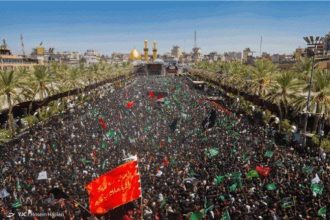
Throughout history and across the globe, devotees of the Prophet’s Ahlul-Bayt (AS) regard the Month of Muharram as a chance to pay homage and remember the extraordinary legacy of Imam Hussain (AS). It is undoubtedly the most pivotal and glorious chapter in his radiant life, marked by the events of Karbala and the circumstances leading to his martyrdom. However, the life of Hussain ibn Ali (AS) was not confined to Karbala alone; his moral and spiritual virtues shone brightly throughout various stages of his life, serving as a beacon of inspiration and guidance.
The following text is a summary of the book The Beauty of Morality: A Glance at the Virtues of Imam Hussain (AS) written by the late Ayatollah Sheikh Lutfullah Safi Golpayegani, translated and published by Shafaqna.
The Call to Devotion
The Spirit of Worship
Ibn ‘Abd Al-Barr and Ibn Athir have reported from Mus’ab ibn Zubayr that he said:
“Hussain (AS) was a man of great virtue and unwavering commitment to his faith. His prayer and fasting were numerous and frequent.” [1]
‘Abdullah ibn Zubayr described his devotion to worship as follows: “Hussain (AS) was awake at night, and he fasted during the day.”
‘Aqqad adds: “In addition to the five daily prayers, he would also perform additional prayers, and he would fast not only during the Month of Ramadhan, but also on certain days in other months. He never missed the Hajj pilgrimage to the House of God, except when circumstances made it impossible for him to do so.” [2]
Imam Hussain (AS) would perform a thousand Rak’ahs of prayer in a single day, and he undertook the Hajj pilgrimage on foot twenty-five times. [3] This is a testament to the perfection of his worship and his humility before God. On one occasion, he grasped the corner of the Kaaba and, in this manner, he offered his prayers, expressing his devotion, and acknowledging his humility before the Almighty God, praising and glorifying God:
اِلهى نَعَمْتَنى فَلَمْ تَجِدْنى شاكِراً وَ ابْتَلَيْتَنى فَلَمْ تَجِدْنى صابِراً فَلا انْتَ سَلَبْتَ النِّعْمَة بِتَرْكِ الشُّكْرِ، وَ لا ادَمْتَ الشِّدَّة بِتَرْكِ الصَّبْرِ الهى ما يَكُونُ مِنَ الْكَريمِ الا الْكَرَم[4]
Oh God! You have bestowed Your blessings upon me, yet I have not been thankful. You have afflicted me with trials, yet I have not been patient. You have not withdrawn Your favors from me due to my ingratitude, nor have You increased the severity of my trials due to my lack of patience. You are the All-Merciful, and it is only fitting that You should be merciful.
To understand the excellence of prayer, worship, and patience of that noble and oppressed Imam (AS), it is sufficient to refer to the well-known Du’a Al-‘Arafah.
The Rain of Mercy
The Patron of the Destitute
Hussain (AS) finished his prayer and stepped out. He noticed a poor Bedouin Arab in need, turned back, and called out to Qanbar. Qanbar responded, “At your service, son of the Messenger of God.”
Hussain (AS) asked: “How much money do we have left for expenses?” Qanbar replied: “We have two hundred dirhams that, as you instructed, I will distribute among the family members.”
Hussain (AS) said: “Bring it! Someone has arrived who is more deserving of that money.” Then he took the money, went out, and gave it to the Bedouin Arab.
I Will Pay Back the Debt
One day, Hussain (AS) visited ‘Usamah bin Zayd at his home to check on his well-being. ‘Usamah was overcome with grief and shared his sorrow with Hussain (AS).
Hussain (AS) asked: “Brother, what is troubling you?” ‘Usamah replied: “I have a debt of sixty thousand dirhams that I am struggling to repay.”
Hussain (AS) reassured him: “Do not worry, I will take care of that for you.” ‘Usamah expressed his concern: “I fear that I will pass away before I can repay my debt.”
Hussain comforted him: “You will not pass away until I have repaid that debt.” And so, he repaid the debt before ‘Usamah’s passing. [5]
A Paradise of Benevolence
The Principles of Hussain (AS)
Hussain (AS) was distinguished for his exceptional social graces and warm interactions with both acquaintances and strangers. His virtues were characterized by an abundance of forgiveness and tolerance.
Jamal Al-Din Muhammad Zarandi, a renowned Hanafi Scholar, narrates that he heard from Imam Zayn Al-‘Abidin (AS), who transmitted from his father Imam Hussain (AS), that he said: “If someone insults me in this ear (and he pointed to his right ear), and then apologizes in my left ear, I will accept their apology; for the Commander of the Faithful (AS) transmitted to me from my grandfather, the Prophet (PBUH), the following Hadith:
لا يَرِدُ الْحَوْضَ مَنْ لَمْ يَقْبَلِ الْعُذْرَ مِنْ مُحِقٍّ اوْ مُبْطلٍ[6]
‘He who does not accept an apology, whether it is from someone who speaks the truth or someone who lies, will not enter the Pool [of Kawthar].’”
Hussain (AS) treated his children, women, relatives, and family members with the utmost respect, love, mercy, kindness, and affection. Ibn Qutaybah narrates that a man came to visit Imam Hassan (AS) and made a request.
The Imam (AS) said: “A request is only worth making if it is for a pressing need, extreme poverty, or a debt that has not been paid and would lead to shame.”
The man replied: “I did not come to visit you but for some of those reasons.” The Imam (AS) ordered that 100 dinars be given to him.
Then the man went to visit Hussain (AS) and made the same request. Hussain (AS) gave the same response as his brother, saying: “A request is only worth making if it is for a pressing need, extreme poverty, or a debt that has not been paid and would lead to shame.”
The man replied: “I did not come to visit you but for some of those reasons.” Hussain (AS) then asked: “How much did my brother give you?”
The man replied: “100 dinars.” Hussain (AS) gave him 99 dinars, because he did not want to be equal to his brother in giving. [7]
Note:
[1] Asad Al-Ghabah, Vol. 2, P. 20; Isti’ab, Vol. 1, P. 378.
[2] Abu Al-Shuhada, P. 73.
[3] Isti’ab, Vol. 1, P. 382; Asad Al-Ghabah, Vol. 2, P. 20; Tadhkirat Al-Khawas, P. 244; Tarikh Ya’qubi, Vol. 2, P. 219; Tarikh Abu Al-Fida’, Vol. 2, P. 107.
[4] Is’af Al-Raghibin, P. 183.
[5] Al-Sūmūww Al-Ma’nā, PP. 151-152. Bayhaqi In Al-Mahasin wal-Masawi, Volume 1, Page 89, narrates the same story and attributes it to Imam Al-Hassan (AS), and on the same page, a story is recounted about these two esteemed brothers, who each bestowed one hundred and fifty thousand dirhams upon a single individual.
[6] Naẓm Durar Al-Simṭayn, P. 209.
[7] Al-Sūmūww Al-Ma’nā, P. 152.
Part of Book: Beauty of Morality by the late Ayatollah Sheikh Lutfullah Safi Golpayegani
Source: Shafaqna English