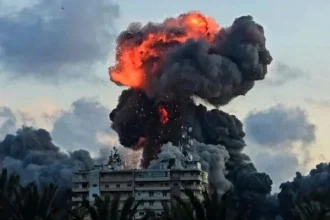
The Iranian Red Crescent Society (IRCS) has said that four people, including two children, were killed in a US strike on a house where a wedding ceremony was taking place. Iranian state television later reported that a 22-year-old woman succumbed to her injuries in hospital, bringing the reported death toll to five. Nearly 70 people were wounded in the Tuesday attack. The incident has once again raised deeply troubling questions about the conduct of the war and the protection of civilians caught in the crossfire.
The strike is disturbingly reminiscent of the February 28 US attack in Minab, which reportedly hit a school compound and killed at least 156 people, most of them schoolchildren. The recurrence of attacks resulting in such heavy civilian casualties should not be dismissed as an unfortunate by-product of war. Iranian Foreign Ministry spokesperson Esmaeil Baqaei described the wedding strike as the “true face of the war crime”, while US Vice President JD Vance, when asked on Thursday whether an American strike was responsible, said that “sometimes things happen” and that Washington was investigating the incident.
Iran, meanwhile, has vowed to avenge those killed. An official of the Islamic Revolutionary Guard Corps (IRGC) said the attack would not go unanswered. Such statements demonstrate the dangerous cycle of retaliation that the widening conflict has created. Every civilian death risks generating another demand for revenge, pushing the region further away from peace and increasing the possibility of an even broader war.
The bitter reality is that serious allegations of war crimes are emerging from the actions of both the United States and Israel, while much of the international community appears unwilling or unable to respond with the urgency such allegations demand. This is the grim reality of the continuing devastation in Gaza as well as the widening conflict involving Iran. The protection of civilian life cannot be treated as a selective principle that applies only when politically convenient.
The Israeli regime has been accused of committing grave violations against Palestinians on a daily basis, particularly since October 2023. It subsequently persuaded Washington that confronting Iran militarily was the right course of action. Now, the United States appears to be caught in a dangerous strategic illusion, continuing its strikes inside Iran despite the risks to civilians and vital infrastructure.
That sense of delusion was evident in US President Donald Trump’s recent social media post in which he again called on the Iranian people to “rise up and fight” against their government. The apparent assumption that military pressure could trigger an uprising and lead to regime change has been central to the thinking behind the confrontation. Yet the opposite appears to have happened. Rather than turning against their government, the Israeli-US war has, according to the argument presented here, strengthened national unity among many Iranians.
Even the killing of Ayatollah Ali Khamenei did not produce the regime change that some in the West may have expected. His son, Mojtaba, subsequently assumed leadership with the reported support of the Iranian nation. This should serve as a reminder that political systems cannot simply be transformed through external military force. Attempts to impose political change from outside often produce instability, resistance and greater suffering rather than the desired outcome.
For decades, however, Western powers have demonstrated an ability to manufacture public consent for military action through political messaging, sections of the media and, at times, voices within the human rights community. The false equivalence between Iran and the United States and Israel that has emerged in recent coverage is therefore unsurprising. Equally troubling is the repeated circulation of narratives and claims portraying Iran as uniquely responsible for regional violence, sometimes without adequate acknowledgement or correction when those claims are subsequently challenged.
The result is a dangerous inversion of reality in which the victim can be portrayed as somehow responsible for the violence inflicted upon it, while the aggressor is presented as having no alternative but to use force because it is supposedly confronting an inherently evil adversary. Such reasoning erodes the very principles of international law and human rights that the international community claims to uphold. Aggression cannot become legitimate merely because it is accompanied by a political narrative about security or regime change.
The world undoubtedly wants an end to the conflict. Oman and Qatar have been attempting to establish a framework for renewed negotiations between Iran and the United States, offering a possible diplomatic path out of the crisis. But the desire for peace should not be confused with an expectation that Iran alone must show restraint in the face of continuing aggression. Calling for de-escalation is meaningful only when all parties responsible for the escalation are held to the same standard.
The consequences of the conflict are already extending far beyond the countries directly involved. Nations with no role in the confrontation are facing the effects of the global energy crisis and economic disruption that the war has helped create. Higher energy costs, uncertainty in international markets and growing geopolitical tensions threaten ordinary people far beyond the immediate battlefield.
If the existing world order genuinely stood for human rights, international law and equality among nations, military aggression would not be treated differently according to the identity or geopolitical influence of the aggressor. The continued violation of the Islamabad Memorandum of Understanding by the United States further reinforces the argument that the international system needs fundamental reform.
A more credible world order must be based on equal standards for all states, accountability for violations of international law and diplomacy rather than military coercion. No country, regardless of its economic or military power, should be able to determine the fate of millions of people or push the wider world towards the brink of a major conflict simply to advance its strategic interests.
The deaths of civilians at a wedding ceremony in Iran should therefore not disappear beneath the noise of war. They should instead remind the world of the human cost of military escalation. If the international community truly seeks peace, it must reject the normalisation of civilian deaths, demand accountability for alleged war crimes and push with urgency for negotiations before the widening conflict causes an even greater catastrophe.
Shafaqna Pakistan
pakistan.shafaqna.com
Note: Shafaqna do not endorse the views expressed in the article