

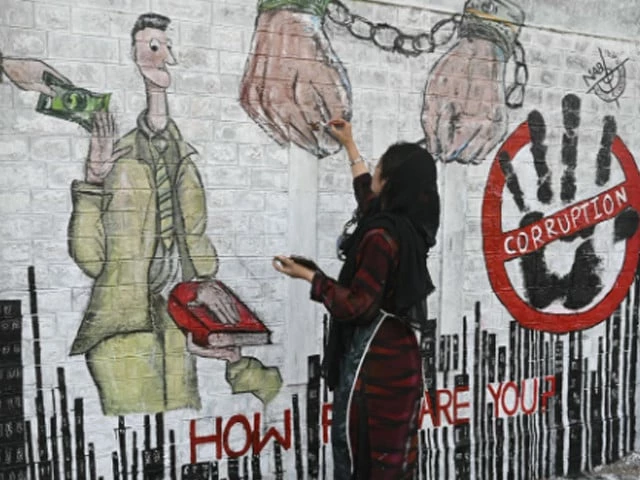
Shafaqna Pakistan: The International Federation for Human Rights (FIDH) has warned that judicial corruption in Pakistan has become systemic and could amount to grand corruption, alleging that the country’s justice system is increasingly vulnerable to political influence and institutional capture.
The observations were made in a report titled Under the Bench: Mapping Corruption Risks in Pakistan’s Justice System.
According to the report’s executive summary, Pakistan’s democratic institutions, including the judiciary, have faced mounting pressure in recent years and have been gradually weakened through executive influence.
The report further claims that this trend has coincided with growing restrictions on fundamental freedoms, enabled by repressive legislation and serious human rights violations, with the judiciary allegedly being used to suppress activists and dissenting voices.
The report says the 26th and 27th Constitutional Amendments have had a significant negative impact on judicial independence and the protection of fair trial rights in Pakistan.
“These developments mark a regressive shift in Pakistan’s legal and constitutional order by completely stripping the limited independence previously enjoyed by the judiciary,” it says.
According to the report, judicial appointments, bench formation and high-level case management are now subject to political influence in ways that contradict international standards for judicial independence.
It further states that these structural distortions at the apex level have also affected the lower judiciary, where judges are influenced by higher courts regarding their conduct and decision-making, increasing the potential for external pressure.
The report recommends repealing both constitutional amendments to restore judicial independence.
Examining judicial corruption, the report states that corruption has become endemic throughout Pakistan’s judicial system, undermining the independence and effectiveness of the judiciary and its ability to uphold fair trial rights and protect fundamental freedoms.
It identifies three interrelated factors enabling corruption: weak administration of justice across all levels of the judicial system leading to bribery and corrupt practices; cultural dynamics that encourage favouritism and nepotism; and the erosion of judicial independence, which has resulted in what it describes as state capture of the superior judiciary.
The report also examines what it calls the failure of existing accountability mechanisms to investigate allegations of corruption effectively and hold those responsible accountable.
It argues that accountability institutions have increasingly been politicised and used as tools for political victimisation rather than as mechanisms to address systemic corruption. It highlights the lack of protection for whistleblowers amid growing restrictions on freedom of expression and shrinking civic space.
According to the report, judicial corruption has serious human rights implications, including violations of due process and equality before the law, particularly affecting low-income communities and minorities.
It also links corruption to the incidence of torture and the application of capital punishment and highlights its adverse impact on gender equality within both the legal profession and the judiciary.
“The report concludes that there are indications that judicial corruption in Pakistan has reached a systemic scale and may amount to grand corruption,” it states.
It also offers a series of recommendations aimed at addressing weaknesses in the administration of justice, improving transparency, strengthening accountability mechanisms, ensuring action against perpetrators of corruption and protecting whistleblowers.
The report says its findings are based on interviews with 30 interlocutors, including four women, who possess knowledge of Pakistan’s justice system. Those interviewed included lawyers, former and retired judgesincluding two former chief justices of Pakistan, former Supreme Court judges and a former high court judgeas well as journalists and representatives of civil society organisations.
The report further states that attacks on judicial independence and fundamental freedoms have been compounded by widespread corruption across public institutions.
Citing Transparency International Pakistan’s 2025 National Corruption Perception Survey, the report says the police are perceived as the most corrupt institution in the country, while the judiciary ranks third nationally.
The FIDH is an international human rights NGO federating nearly 200 member organisations. Since 1922, the FIDH has been defending all civil, political, economic, social and cultural rights as set out in the Universal Declaration of Human Rights, according to its website.
Source: Express Tribune


