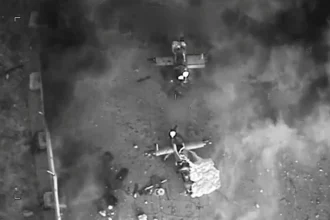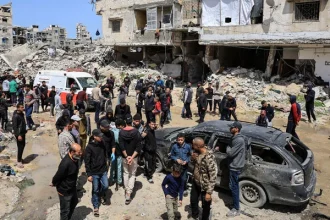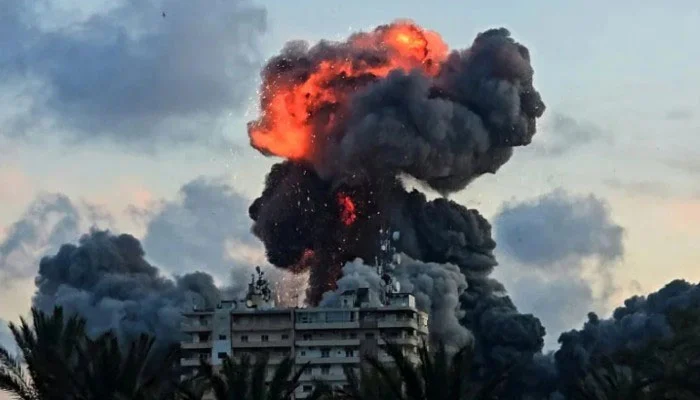
The renewed military confrontation between the United States and Iran is pushing an already fragile Middle East towards one of its most dangerous moments in years. Every fresh exchange of military strikes increases the likelihood of a broader regional war while simultaneously diminishing the prospects for diplomacy. What initially appeared to be a limited escalation has rapidly evolved into a confrontation with consequences that extend far beyond Washington and Tehran, threatening global energy markets, international trade and the security of several Gulf states.
US President Donald Trump has adopted an uncompromising posture, declaring that military operations against Iran “will continue until I say it’s enough.” He has also suggested that further strikes could continue into the coming week, signalling that Washington has little intention of de-escalating in the immediate future. At the same time, the United States has resumed a naval blockade of Iranian ports, while US Central Command (CENTCOM) says that more than twenty US Navy warships and hundreds of military aircraft are currently deployed across the Middle East. Such a massive military presence underscores the seriousness of the crisis and raises concerns that even a minor miscalculation could trigger a much larger conflict.
Iran has responded by escalating its own rhetoric and military posture. The Islamic Revolutionary Guard Corps (IRGC) has warned that the Strait of Hormuz will remain closed until the United States halts what Tehran describes as its “acts of aggression.” Iranian officials have also warned that additional strategic waterways and energy export routes used by the United States and its regional partners could become targets should hostilities continue. The IRGC has further claimed responsibility for attacks on US military installations in Bahrain and Kuwait following American strikes on Iranian territory, highlighting the growing danger that the conflict could spread across multiple fronts.
The repercussions are already extending well beyond the principal combatants. Pakistan’s Prime Minister Shehbaz Sharif has condemned attacks targeting Saudi Arabia, reflecting Islamabad’s concern over the deteriorating regional security environment. His remarks followed Saudi Arabia’s announcement that coalition forces had intercepted ballistic missiles launched by Yemen’s Houthi movement towards the Kingdom’s southern regions. These developments demonstrate how quickly regional proxy conflicts can become intertwined with direct US-Iran hostilities, creating an increasingly volatile security landscape.
The current trajectory resembles a dangerous chain reaction in which every military response invites another, making de-escalation progressively more difficult. Critics argue that President Trump’s decision to abandon the ceasefire while Iranians were mourning their late Supreme Leader, Ayatollah Ali Khamenei, further undermined confidence in diplomatic efforts. Whether intended or not, such actions reinforce perceptions that ceasefires are treated as temporary tactical pauses rather than genuine opportunities to pursue lasting peace. Continued military exchanges also threaten to erode confidence in diplomatic agreements, including the interim Islamabad Memorandum of Understanding reportedly reached in June, which sought to address disputes surrounding the Strait of Hormuz and establish a framework for reducing tensions.
International concern over the growing crisis continues to mount. China has urged both Washington and Tehran to exercise restraint and avoid returning to full-scale war. Pakistan has similarly called for dialogue and diplomatic engagement as the only viable path to stability. Despite these appeals, prospects for meaningful negotiations remain uncertain as both sides continue to prioritise military responses over political solutions.
The economic consequences of continued escalation are becoming increasingly apparent. Renewed US naval operations around Iranian ports, coupled with Iranian retaliation against American military assets, have once again driven global oil prices higher. Any prolonged disruption to shipping through the Strait of Hormuz—a route through which a significant share of the world’s oil and liquefied natural gas exports passes—would have profound implications for global energy supplies, inflation and economic growth. Gulf Cooperation Council (GCC) countries, despite their extensive energy resources, would also face substantial economic and security challenges if instability persists.
Many Gulf governments have consistently urged restraint, warning that prolonged confrontation threatens both regional prosperity and international energy security. Several GCC states have advocated diplomatic solutions rather than military escalation, recognising that any expansion of the conflict would inevitably place their own economies and infrastructure at greater risk. The presence of numerous US military bases across the Gulf, historically justified as a deterrent against regional threats, has also become a source of growing concern, as these installations could become targets during a wider conflict.
Ultimately, another prolonged war in the Middle East would serve neither regional stability nor global economic interests. Military escalation offers little prospect of a sustainable resolution while significantly increasing the risks of humanitarian suffering, economic disruption and broader geopolitical instability. The international community should intensify efforts to encourage direct dialogue between Washington and Tehran, support existing diplomatic frameworks, and promote measures that reduce rather than inflame tensions. Durable peace will require restraint from all parties, respect for international diplomacy and a renewed commitment to negotiations. However imperfect diplomacy may be, it remains a far more viable path than a conflict that promises only greater destruction and uncertainty.
pakistan.shafaqna.com
Note: Shafaqna do not endorse the views expressed in the article