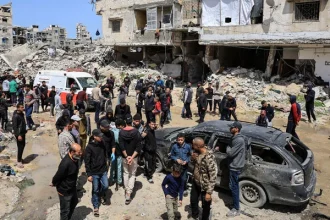
The political consensus surrounding Israel in the United States appears to be undergoing a gradual but noteworthy transformation. For decades, unwavering support for Israel has been one of the few issues to command broad bipartisan agreement in Washington, with both Republicans and Democrats generally backing military aid and diplomatic support regardless of the party in power. While there is little indication that the United States is abandoning its strategic alliance with Israel, recent developments in Congress suggest that a growing number of lawmakers are willing to challenge long-standing assumptions about America’s Middle East policy. This emerging debate reflects changing political dynamics, evolving public opinion and increasing concern over the humanitarian consequences of the conflict in Gaza.
These shifting attitudes were highlighted during a recent vote in the US House of Representatives, where a significant number of Democratic lawmakers supported an amendment seeking to restrict American military assistance to Israel. Although the proposal was ultimately defeated, the level of support it received marked a departure from the near-unanimous backing that Israel has traditionally enjoyed in Congress. The vote underscored an expanding divide within American politics between the established foreign policy consensus and a newer generation of legislators advocating greater scrutiny of military aid, human rights and civilian protection in conflict zones.
Lawmakers from both major political parties contributed to this evolving debate. Republican Representative Thomas Massie joined several Democratic colleagues, including prominent progressive voices such as Ilhan Omar, in questioning the continuation of unconditional military assistance. While their motivations may differ, these legislators share the view that American foreign policy should remain consistent with the country’s stated commitment to human rights, accountability and the rule of law. Their willingness to challenge conventional policy illustrates a broader trend in which foreign assistance is increasingly being examined through the lens of humanitarian principles as well as strategic interests.
Although the amendment did not pass, the sizeable number of votes in its favour sent an unmistakable political signal. It demonstrated that support for Israel is no longer entirely immune from debate within Congress and that lawmakers are becoming more responsive to shifting public attitudes, particularly among younger Americans. Public opinion surveys in recent years have shown growing concern over civilian casualties in Gaza and increasing demands for greater accountability in the use of American military assistance abroad. These developments suggest that future congressional debates on US policy toward Israel may become more contested than in previous decades.
Domestic political considerations are also influencing this shift. As members of Congress prepare for upcoming elections, many are increasingly attentive to voters who favour a more restrained foreign policy and question prolonged military commitments overseas. The broader American public has shown signs of fatigue with costly international conflicts, encouraging some legislators to advocate diplomacy, oversight and conditional assistance rather than unconditional support. This changing political environment is gradually reshaping discussions about America’s broader role in the Middle East.
Beyond domestic politics, Washington is also confronting a rapidly evolving regional landscape. The Middle East has become increasingly multipolar, with regional powers pursuing more independent foreign policies and diversifying their international partnerships. Arab states have expanded diplomatic and economic ties with countries such as China and Russia while simultaneously maintaining relations with the United States. These developments require American policymakers to balance their longstanding commitment to Israel with broader strategic interests across the region, including energy security, regional stability and counterterrorism cooperation.
Whether these emerging trends ultimately produce a fundamental shift in US foreign policy remains uncertain. The United States continues to regard Israel as a critical strategic ally, and bipartisan support for the relationship remains substantial. Nevertheless, the recent congressional debate illustrates that America’s policy toward Israel is no longer beyond public or political scrutiny. As humanitarian concerns, domestic political pressures and changing geopolitical realities continue to shape Washington’s foreign policy discourse, the long-established consensus may evolve into a more nuanced and conditional approach. Such a development would not necessarily weaken the US-Israel partnership but could redefine the terms under which that relationship is sustained in the years ahead.
Shafaqna Pakistan
pakistan.shafaqna.com
Note: Shafaqna do not endorse the views expressed in the artice